
Many industrial units in Gujarat treat waste compliance as a mere paperwork exercise until a surprise audit by the Gujarat Pollution Control Board (GPCB) halts operations. Obtaining the darbar group quality certification ensures your waste processing workflows meet strict municipal and industrial safety benchmarks, preventing costly operational shutdowns. In the chemical belts of Vapi, Ankleshwar, and Vatva, a single day of forced closure can wipe out a quarter’s profit margins. This is not about hanging a framed certificate on an office wall: it is about establishing a verifiable, field-tested protocol for handling, segregating, and disposing of industrial and municipal waste without legal or environmental friction.
For factory managers and municipal commissioners alike, the real challenge is not understanding the rules; it is enforcing them on the ground. When hazardous waste leaves your facility, your liability does not end at the security gate. If a transporter dumps toxic sludge in an unauthorized landfill, the finger points directly back to the generator. Implementing a recognized, systematic verification protocol protects your organization from these liabilities by standardizing every link in the waste custody chain.
The Reality of Waste Management in Gujarat’s Industrial Corridors
Gujarat is home to some of the largest chemical and manufacturing clusters in India. With rapid industrial growth comes an unprecedented volume of complex waste streams: from highly reactive chemical effluents to mixed municipal solid waste. The traditional approach of handing waste to the lowest-bidding contractor is no longer viable. GPCB regulations have become increasingly precise, and tracking mechanisms like the XGN (Extended Green Node) portal make every transaction transparent to regulators.
In this strict regulatory environment, operational consistency is your only real shield. Many facilities rely on outdated treatment systems that fail during peak production cycles or monsoon seasons. When your internal effluent treatment plant (ETP) underperforms, or your solid waste storage area overflows, you face immediate penalties. A structured operational audit helps identify these vulnerabilities before they turn into regulatory violations. By standardizing your waste segregation at the source, you can significantly lower your treatment costs and improve your compliance track record.
Why do standard compliance checklists fail?
Standard compliance checklists fail because they are static documents trying to govern dynamic industrial processes. A factory might pass an annual inspection on a Tuesday morning when production is low, only to suffer an environmental failure on Friday night when operating at full capacity. These checklists do not account for variations in raw material quality, human error during shift changes, or the gradual degradation of waste treatment machinery.
To build a truly compliant operation, you must integrate waste management directly into your daily production workflows. This requires continuous monitoring of waste generation rates, regular calibration of treatment equipment, and thorough training for shop-floor operators. If you are handling complex chemical waste, you can find specific operational guidance on our hazardous waste management page, which outlines real-world strategies for maintaining compliance under peak loads.
Deconstructing the darbar group quality certification
This certification is not a generic management standard: it is a practical operational framework built specifically for the Indian waste management sector. It focuses on concrete field realities rather than abstract policy statements. When a facility undergoes this verification process, auditors inspect the physical path of waste from the exact point of generation to its final destruction or co-processing site.
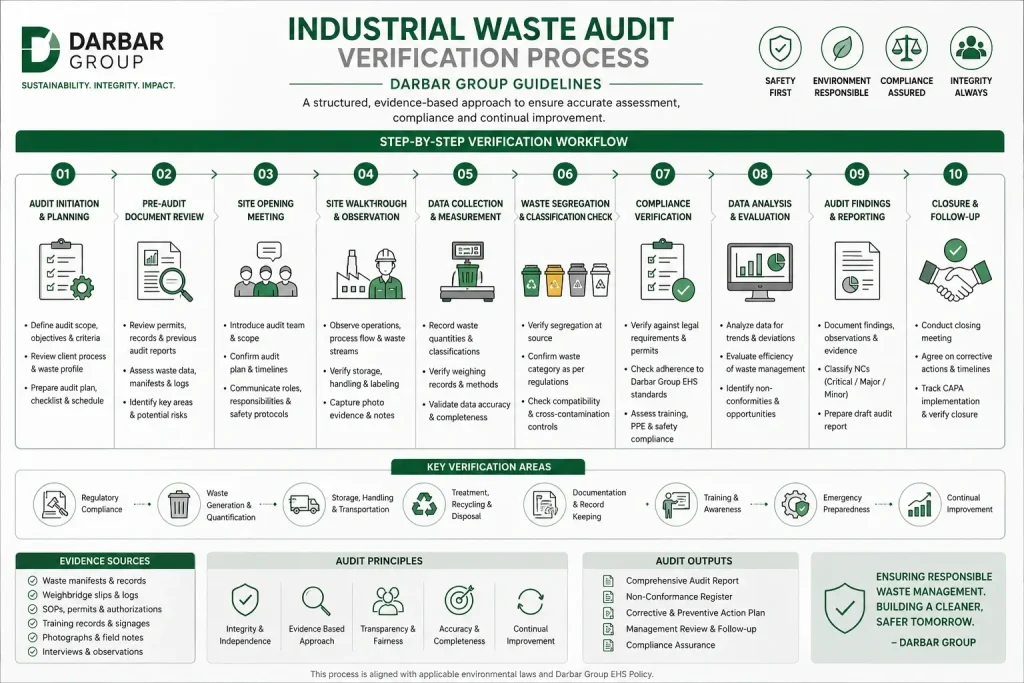
The verification process evaluates three core areas: material balance accuracy, storage integrity, and transport safety. Material balance ensures that the quantity of raw materials entering your plant matches the volume of finished products and waste generated. This prevents illegal off-the-books dumping. Storage integrity assessments check if your hazardous waste storage areas are built to withstand chemical corrosion and heavy rainfall. Transport safety protocols verify that every waste-carrying vehicle is properly permitted, GPS-tracked, and equipped to handle emergencies.
How does this protocol differ from generic ISO standards?
Generic standards like ISO 14001 confirm that you have an environmental policy and a system to review it, but they do not verify if your ETP operators are actually testing pH levels every hour. The darbar group quality certification bridges this gap by mandating specific, industry-tested operational steps. It requires practical, hands-on verification of waste treatment processes, ensuring that your environmental protection measures are active and functional, not just documented on paper.
For example, while an ISO auditor might check if you have a spill response plan, a Darbar auditor will inspect the physical condition of your containment dykes, verify the chemical compatibility of your absorption materials, and interview the actual workers responsible for cleaning up a spill. This level of detail is what protects your facility from catastrophic operational failures. You can learn more about these practical field-level interventions by exploring our industrial waste solutions portal.
Operational Benefits for Municipal Bodies and GIDCs
Municipal corporations in cities like Ahmedabad, Surat, and Vadodara face massive challenges in managing municipal solid waste (MSW). Legacy waste dumps are reaching capacity, and public pressure to improve urban sanitation is growing. For government bodies, partnering with certified waste handlers is the most effective way to ensure public funds are spent on genuine, environmentally sound waste processing rather than simple dumping.
When municipal solid waste is processed under standardized quality protocols, the output becomes a usable resource. For instance, high-quality refuse-derived fuel (RDF) can be produced from dry waste and supplied to cement plants for co-processing. This reduces the volume of waste going to landfills and provides municipal bodies with a steady stream of revenue. However, cement kilns will only accept RDF that meets strict moisture, ash, and calorific value standards. Standardized quality protocols ensure your processing facilities consistently meet these industrial specifications.
Can municipal corporations reduce landfill pressure using these protocols?
Municipal corporations can dramatically reduce their landfill footprint by implementing standardized waste segregation and processing workflows. The key is to treat waste as a manufacturing feedstock rather than a disposal headache. By applying strict quality control to the composting of organic waste and the shredding of non-recyclable plastics, municipalities can divert up to seventy percent of incoming waste away from landfills.
This systematic approach also minimizes the risk of landfill fires, which are often caused by the uncontrolled decomposition of mixed organic waste. When waste is properly segregated and processed according to certified guidelines, methane generation is controlled, and flammable materials are safely diverted for industrial use. This improves public health and saves millions of rupees in emergency municipal management costs.
“In industrial waste management, a broken chain of custody is not a minor mistake: it is a legal liability under the Environment Protection Act that can shut down your entire business.”
Mitigating Risk and Liability for Factory Managers
As a factory manager, you are personally responsible for the environmental impact of your unit. If toxic waste from your plant contaminates local groundwater, the legal and financial consequences can be devastating. Implementing the darbar group quality certification protocols within your facility helps you establish a clear, legally defensible record of responsible waste handling. It shows regulators that you have taken every reasonable precaution to prevent environmental contamination.
This verification process also helps you optimize your internal waste management costs. By identifying inefficiencies in your ETP or solid waste segregation lines, you can reduce the volume of waste that requires expensive secure-landfill disposal. In many cases, clean segregation allows you to sell certain waste byproducts to authorized recyclers, turning a compliance cost into a modest source of revenue.
Is co-processing a viable alternative to landfilling?
Co-processing is the most sustainable alternative to landfilling for high-calorific industrial waste. By burning hazardous waste as an alternative fuel in cement kilns, you completely destroy the toxic organic compounds at temperatures exceeding 1400 degrees Celsius. This leaves no ash residue and reduces the cement plant’s reliance on coal. It is a true circular-economy solution that eliminates your long-term landfill liability.
However, co-processing requires absolute chemical consistency. Cement manufacturers will reject any consignment of waste that contains high levels of chlorine, heavy metals, or moisture, as these elements damage their kilns and alter the quality of the cement. Implementing a certified quality protocol ensures that your waste streams are pre-treated, blended, and tested to meet the exact specifications required by cement plants, making co-processing a reliable, daily reality for your factory.
Taking the Next Step in Your Compliance Journey
Achieving the darbar group quality certification is the first step toward bulletproofing your industrial waste operations. It signals to your clients, regulators, and local communities that your business operates at the highest level of environmental responsibility. In an era where global supply chains demand clean, compliant manufacturing partners, this operational standard gives you a distinct competitive advantage.
Do not wait for a regulatory notice or an environmental incident to audit your waste workflows. Contact our engineering team today to schedule an initial gap analysis of your waste handling systems.
Book a technical waste audit with our team today
Frequently asked questions
What is the main focus of this industrial certification?
The primary focus of this certification is to verify the physical, on-the-ground compliance of waste handling, segregation, transport, and disposal processes, ensuring they meet strict environmental and municipal safety standards.
How long does the verification process take for a mid-sized factory?
For a typical mid-sized industrial unit, the complete audit, gap analysis, and final certification process takes between four to six weeks, depending on the complexity of your waste streams.
Does this certification replace GPCB clearances?
No, it does not replace official government clearances. It acts as an operational verification framework that helps you consistently meet and exceed GPCB standards, reducing the risk of audit failures.
How does it help municipal waste handling?
It standardizes the segregation and processing of municipal solid waste, helping local bodies produce high-quality RDF and compost that meet industrial and agricultural standards, thereby reducing landfill volumes.
What are the key parameters evaluated during the audit?
Auditors evaluate material balance accuracy, waste storage container integrity, spill containment systems, worker safety protocols, and the verifiability of your final disposal pathways.