
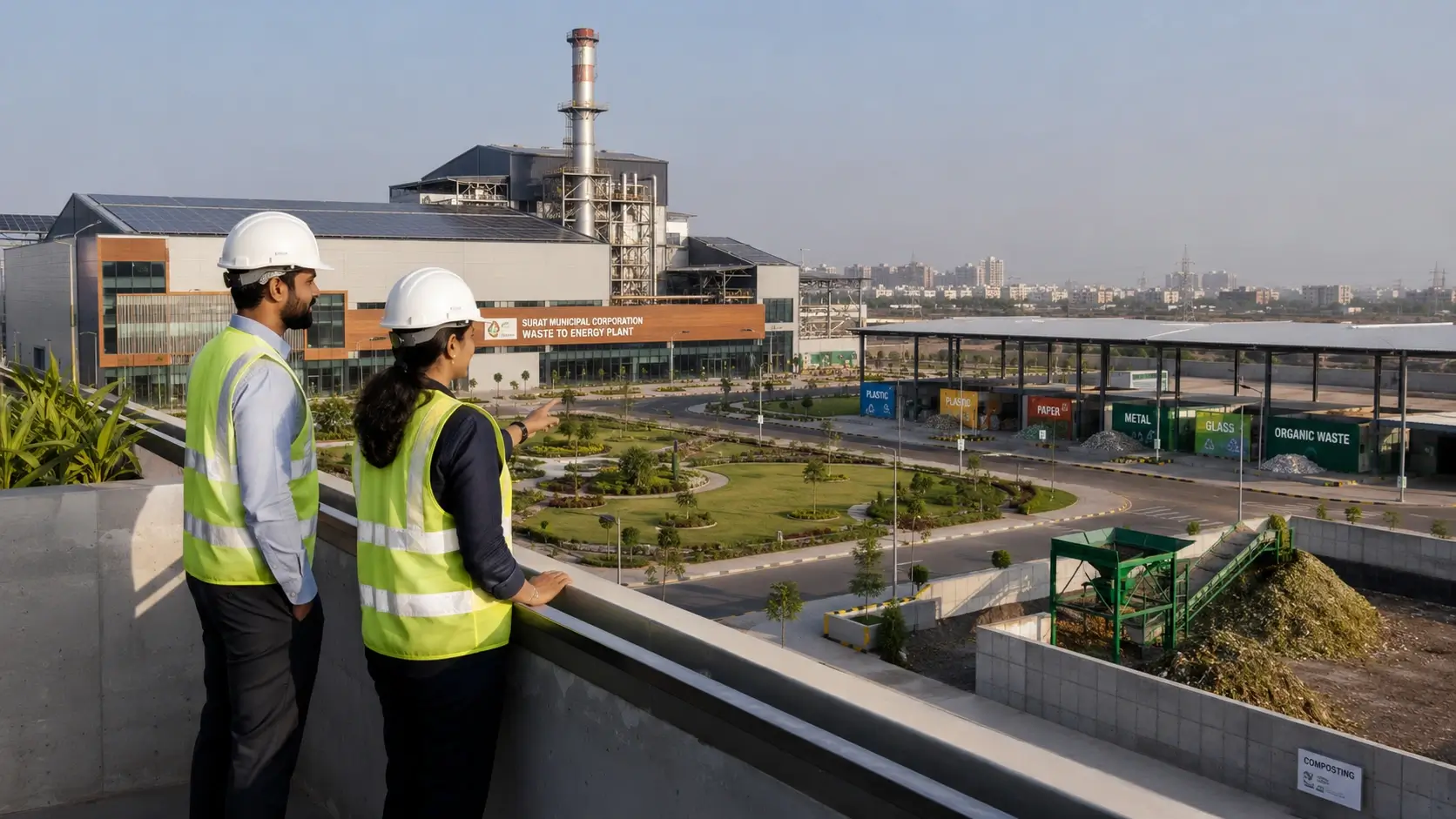
Most municipal commissioners in Gujarat know that the real breakdown in city cleanliness does not happen at the collection bin, it happens when mixed garbage hits the transport link. Implementing a systematic waste cycle management program is the only way to prevent soaring transport costs and stop local dump sites from catching fire every summer. We are not buying more green and blue bins: we are tracking every metric ton from the household curb to its final processing destination. In cities like Surat, Rajkot, and Ahmedabad, municipal corporations face intense pressure to improve Swachh Survekshan rankings while keeping operating budgets under tight control. Relying on simple haulage contracts without end-to-end tracking is a recipe for leaked revenue and unmanaged dumpsites.
When municipal departments do not coordinate collection routes with processing plant capacities, operational bottlenecks form immediately. For example, a composting facility designed to handle fifty tons of wet waste daily becomes useless when flooded with eighty tons of unsegregated plastic and organic matter. This mismatch leads directly to illegal dumping and environmental complaints. True efficiency requires a system where every link, from household segregation to the sale of refuse-derived fuel, is synchronized.
Why municipal waste cycle management in Gujarat demands a system overhaul
Many urban local bodies across Saurashtra and Central Gujarat operate under the illusion that because their tipper trucks are on the streets, their waste problem is under control. The reality is that collection is merely the first step in a complex sequence that often fails at the transfer station. Without tracking the entire flow, municipalities pay tipping fees for moisture-laden mixed waste that cannot be processed. This drives up municipal expenditures while failing to meet the strict Swachh Bharat Mission metrics.
By establishing clear tracking systems, city administrators identify exactly where clean recyclables mix with organic waste. This segregation at the neighborhood level determines whether municipal processing plants succeed. When waste is mixed, the cost of sorting it at a central facility becomes high, leading to system abandonment and reliance on simple dumping.
Is simple waste collection enough?
Collection without processing just moves an environmental crisis from a residential neighborhood to a landfill site. When a municipality reports high door-to-door collection rates but ignores the recovery stage, it merely accelerates the filling of local dumpsites. This causes legacy waste issues that cost millions of rupees to remediate later through expensive bio-mining operations. True success lies in minimizing the material that reaches the landfill by maximizing recovery at the source.
Why do local processing plants run below capacity?
Most compost and plastic recycling plants in Gujarat run under-capacity because of poor feedstock quality. Wet waste must be clean to produce high-grade organic compost that farmers in Anand or Mehsana will purchase. When plastic wrappers, broken glass, and household chemicals mix with kitchen waste, the resulting compost contains heavy metals. This makes the product unsellable, leaving processing plants with mountains of useless residue and forced downtime.
The operational friction points in Gujarat’s municipal corridor
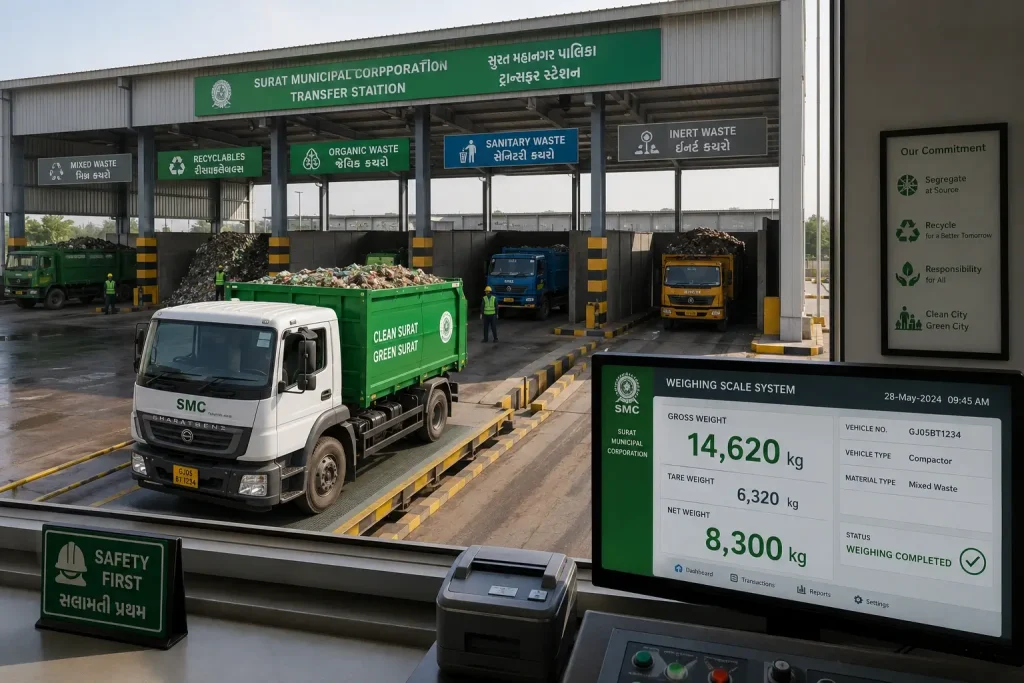
Managing public services in rapidly expanding cities like Vadodara or emerging industrial hubs in Morbi presents distinct operational challenges. Industrial waste often mixes with municipal streams, complicating the treatment process. Municipalities must enforce strict segregation rules on commercial entities while optimizing their own collection fleets. This requires moving away from manual logbooks and adopting digital weight-monitoring systems at every transit point.
A municipal corporation that cannot account for the daily weight difference between its collection trucks and its processing facility is losing money to ghost trips and water-soaked waste.
To address this, some administrative teams use GPS tracking on all waste vehicles. However, GPS only shows where a truck went, not what it carried. The integration of weighbridges with automated data logging prevents contractors from inflating tonnage. By comparing the weight of dry waste arriving at material recovery facilities against the output sold to recyclers, administrators audit the efficiency of the entire system. You can explore how we structure these industrial and municipal waste services to bring transparency to local operations.
Can small urban local bodies afford high-tech monitoring?
Smaller Nagarpalikas often assume that advanced tracking systems require massive capital outlays. This is a common misconception. Simple cloud-based weight logging and basic mobile applications for truck drivers are cost-effective and can be deployed with minimal training. These systems pay for themselves within months by eliminating fuel theft, reducing unauthorized route diversions, and ensuring that contractors receive payment only for verified, processed waste.
How do GPCB regulations impact daily collection routes?
The Gujarat Pollution Control Board enforces strict penalties for the open burning of waste and improper handling of hazardous components. Municipalities that do not maintain separate pathways for domestic hazardous waste, such as batteries, sanitary waste, and electronic items, risk heavy environmental compensation fines. Route planning must incorporate designated collection days or separate truck compartments for these materials to keep the general waste stream clean and compliant with current environmental laws.
Writing Style Implications
In our municipal communications and technical reporting, the choice of visual presentation directly impacts operational clarity. When presenting complex waste metrics to city engineers and administrative officers, we utilize our design system font, Menlo, to present raw data and tonnage figures. This monospace typography ensures that tabular data, such as daily wet waste processing yields or moisture content percentages, remains easy to scan and free from misinterpretation. Clean tables prevent calculation errors that could lead to under-designed processing plants.
We also apply our primary forest green color, #0d9643, specifically to flag successful recovery milestones and actionable steps. This visual distinction helps busy municipal managers quickly identify high-priority directives and compliance checkpoints within dense policy documents. By combining structured layout design with clear, direct prose, we ensure that municipal staff can transition from reading guidelines to executing field operations without administrative friction. Our approach to industrial waste solutions reflects these same standards of precision and clarity.
Implementing a practical circular model in your municipality
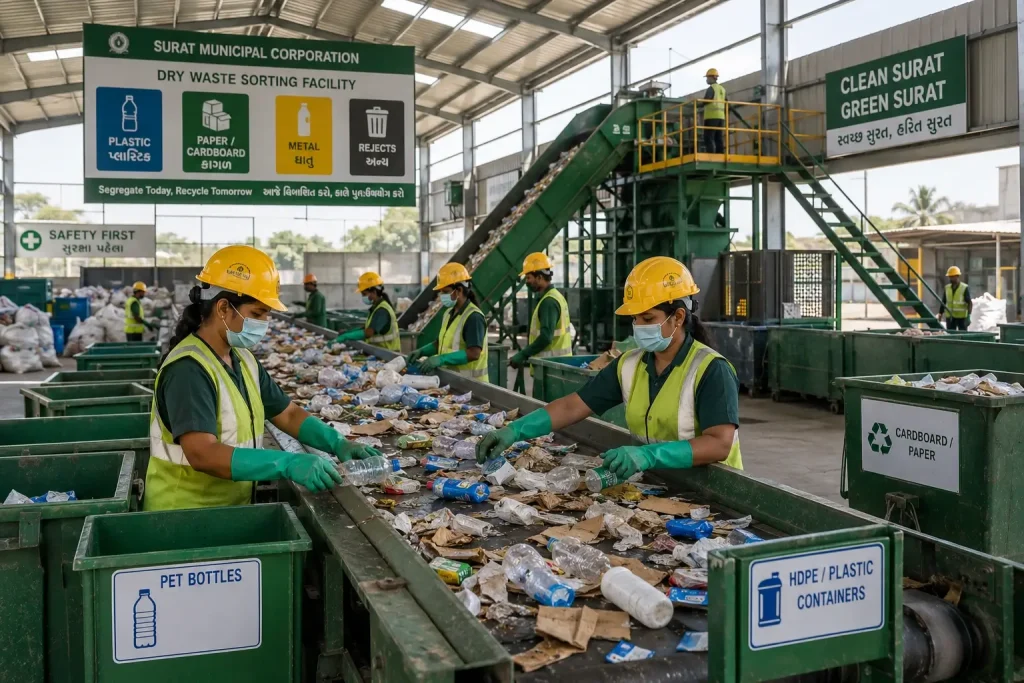
Transitioning to a circular economy model requires a shift in how city leaders view garbage. Instead of treating waste as a liability that must be buried, successful municipalities treat it as a resource stream. This involves setting up decentralized dry waste processing centers where local waste pickers are integrated into the formal economy. This integration reduces municipal labor costs while providing stable livelihoods to marginalized communities.
For wet organic waste, establishing decentralized composting units near large vegetable markets, like those in Ahmedabad or Surat, eliminates the need to transport heavy, wet material across the city. This reduces fuel consumption and wear on vehicles. The produced compost can be used directly by the municipal parks department or sold to agricultural cooperatives, creating a self-sustaining financial cycle that offsets operating costs.
What is the real cost of ignoring dry waste recovery?
Ignoring dry waste recovery leads directly to shorter landfill lifespans and increased transport costs. Every ton of recyclable paper, plastic, and metal that is buried represents lost revenue and wasted space. Landfill acquisition in rapidly growing regions of Gujarat is expensive and politically difficult due to local resistance. By recovering these materials, municipalities extend the life of their existing landfills by decades, saving billions of rupees in future land acquisition costs.
Optimizing your city’s waste operations
Managing municipal waste does not have to be an endless cycle of rising costs and public complaints. By focusing on smart tracking, clear segregation protocols, and localized waste cycle management, your urban local body can achieve both financial sustainability and environmental compliance. Our team at Darbar Group has the hands-on operational experience required to help Gujarat’s municipalities design and run efficient waste programs. To discuss how we can assist your administration in auditing and upgrading its current collection and processing systems, contact our municipal advisory team today to schedule a detailed operational assessment.
Frequently asked questions
How can small municipalities in Gujarat start with systematic waste handling?
Small municipalities can start by establishing basic material recovery facilities and enforcing source segregation in just two or three pilot wards. This minimizes initial capital expenditure while proving the operational viability of segregated collection before scaling citywide.
What are the current GPCB rules for municipal solid waste processing?
The Gujarat Pollution Control Board requires all urban local bodies to completely stop the landfilling of unprocessed organic waste. Municipalities must set up operational composting or biomethanation units and ensure that only non-recyclable, non-biodegradable inert waste reaches scientific landfills.
Why is wet waste segregation so difficult to enforce in residential areas?
Enforcement fails when there are no immediate consequences for non-compliance. Successful cities use a combination of clear color-coded bin distribution, consistent daily collection schedules, and a strict no-segregation-no-collection policy to establish compliant household habits.
How can municipalities reduce the cost of legacy waste bio-mining?
Municipalities can lower bio-mining costs by partnering with local cement manufacturers to take dry combustible fractions as refuse-derived fuel. This reduces the volume of material that must be screened and transported, lowering overall processing costs per metric ton.
What is the role of cement plants in municipal waste disposal?
Cement plants in Gujarat serve as critical off-takers for non-recyclable plastic and high-calorific dry waste, using it as co-processing fuel in their kilns. This provides municipalities with a reliable outlet for materials that would otherwise occupy limited landfill space.